

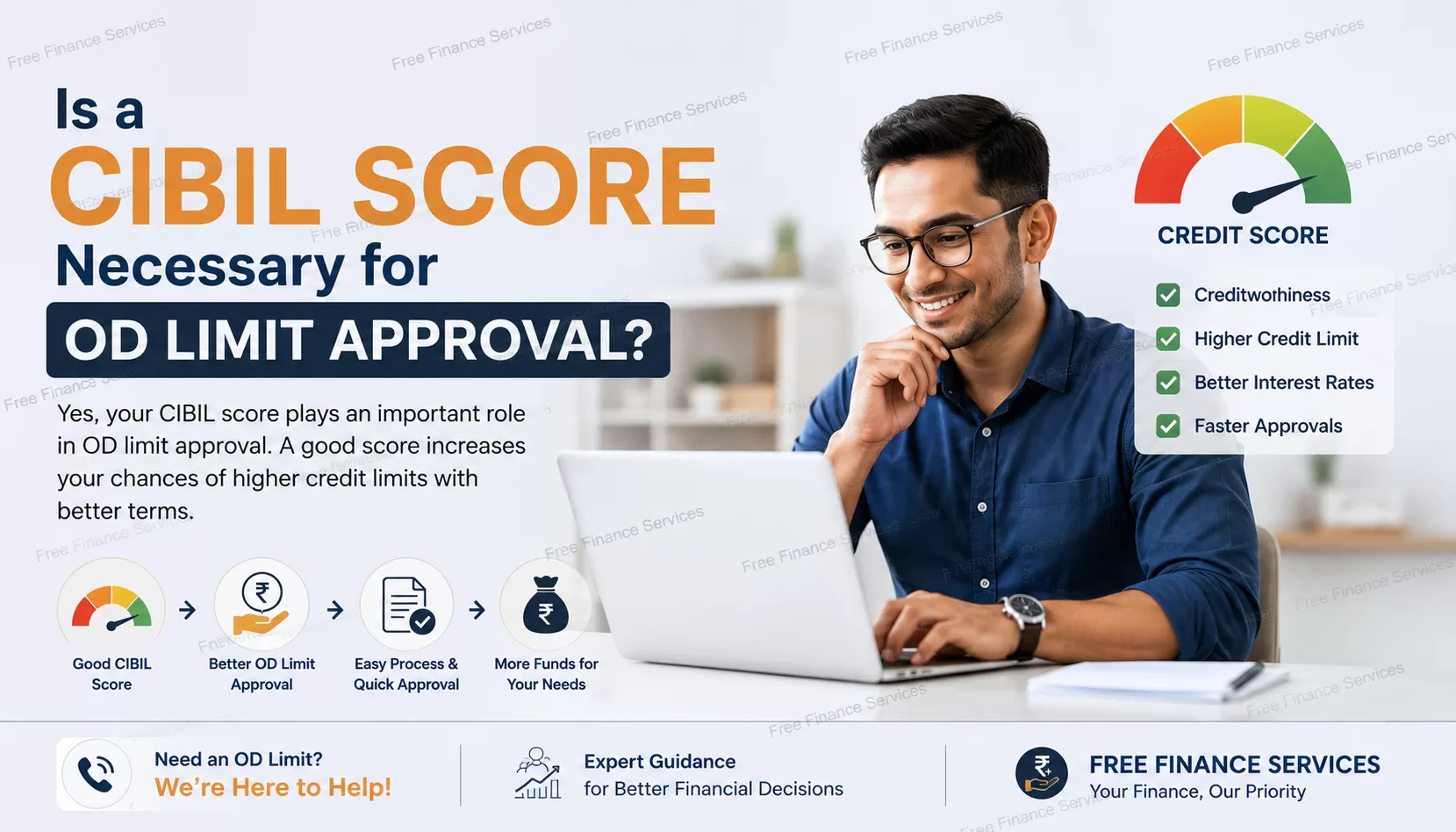

Short answer: Usually yes. Most banks and NBFCs consider your CIBIL (credit) score while approving an Overdraft (OD) limit because it reflects your repayment history, credit behaviour, and overall risk. A healthy score increases your chances of approval and can help you get a better limit and interest rate. But the full story is a bit more nuanced—especially for secured OD/CC against Property, OD against FD, and business OD. Let’s break it down in simple terms. 👇
💡 What is an OD (Overdraft) and why do lenders check CIBIL?
An OD is a revolving credit line—you get a sanctioned limit and you pay interest only on the amount you actually use, for the number of days you use it. Because it’s flexible, lenders want to ensure you’re a responsible borrower. Your CIBIL score (typically ranging from 300–900) helps them quickly assess:
- ✅ Your past repayment discipline (EMIs/credit cards paid on time?)
- ✅ Your current leverage (existing loans/credit limits)
- ✅ Any delinquencies or write-offs
🏁 When is CIBIL score critical for OD approval?
- Unsecured OD / Salary OD: Because there is no collateral, lenders rely heavily on your CIBIL score, salary credits, job stability, and employer category. A higher score (often 700+) is usually preferred for smooth approval. 🎯
- Business OD (without collateral): Credit score matters along with bank statements, GST filings, ITRs, and cash flow consistency. Strong CIBIL improves the approval odds and pricing. 📈
🏠 When can a lower CIBIL be tolerated?
- OD/CC Against Property (LAP OD): Since your property is mortgaged, lenders may accept a moderate score if other factors are strong (stable income, clear property title, sufficient valuation). However, very low scores or recent defaults can still hurt approval or reduce the sanctioned limit.
- OD Against Fixed Deposit (FD): This is one of the most lenient categories because the FD is a highly liquid security. Even with a modest score, you can often get an OD up to a percentage of FD value. Many banks process this quickly and at attractive interest (FD rate + spread). 💎
📋 What else do lenders evaluate beyond CIBIL?
While CIBIL is important, approval is a holistic decision. Typical checks include:
- Bank Statements: Average balance, cheque bounces, end-of-month dips.
- Income Proof: Salary slips/Form 16 for salaried; ITR, GST returns, and P&L for business owners.
- Obligation Ratio: Total EMIs vs net take-home (for salaried) or DSCR for businesses.
- Collateral Quality: For property-backed OD—location, market value, title clarity, and LTV.
- KYC & Stability: Address stability, job/business continuity, compliance track record.
🎯 What CIBIL score is “good” for OD?
- 750+: Excellent—usually enables faster approvals and better terms.
- 700–749: Good—generally acceptable; rate/limit may vary by profile.
- 650–699: Fair—possible with strong income/collateral; terms may be tighter.
- <650: Challenging—consider improving score or opting for secured OD (FD/property) first.
🧮 Example scenarios
- Salaried Professional (Unsecured OD): CIBIL 760, stable salary in a reputed company → high approval probability and competitive interest.
- SME Owner (Business OD with LAP): CIBIL 680, strong financials, clear property collateral → approval likely, though pricing may be a bit higher.
- OD against FD: CIBIL 600, ₹5 lakh FD → OD feasible because FD secures the bank’s risk.
🛠️ How to improve your CIBIL for better OD terms
- 📆 Pay on time: EMIs/credit cards before the due date—set auto-pay.
- 📉 Lower credit utilization: Keep credit card usage ideally under 30–40% of the limit.
- 🧾 Clean old issues: Settle disputes and request lenders to update status with bureaus.
- 🔁 Build positive history: Maintain a mix of credit (secured + unsecured) and avoid frequent inquiries.
- 🔎 Check your report: Fix wrong entries; monitor score monthly.
⚠️ Common reasons for OD rejection (even with decent CIBIL)
- 🚫 Multiple recent loan inquiries indicating credit hunger.
- 💳 High unsecured exposure vs income or cash flows.
- 📉 Frequent cheque bounces or low average bank balance.
- 🏚️ Collateral issues (for LAP OD): unclear title, valuation gaps, or high existing LTV.
✅ Key takeaway
Yes, CIBIL score is generally necessary and highly influential for OD approval—especially for unsecured or salary-based overdrafts. For secured OD like against Property or FD, lenders may be flexible with mid-range scores if other factors are strong. To maximize approval chances and secure better pricing, focus on improving your score, keeping your bank statement clean, and choosing the right OD product for your profile. 🌟
🚀 Quick next step
Not sure which OD product suits your profile or how your CIBIL will impact approval? Our team can assess your case and suggest the fastest, most cost-effective route—whether it’s Salary OD, Business OD, OD against Property, or OD against FD. We’ll guide you on documents, eligibility, and how to strengthen your application. 🤝
Quick Contact: Need expert help or instant eligibility guidance? Click here to Apply Now ✨
📞 Call us – 9910831827 | Apply Now